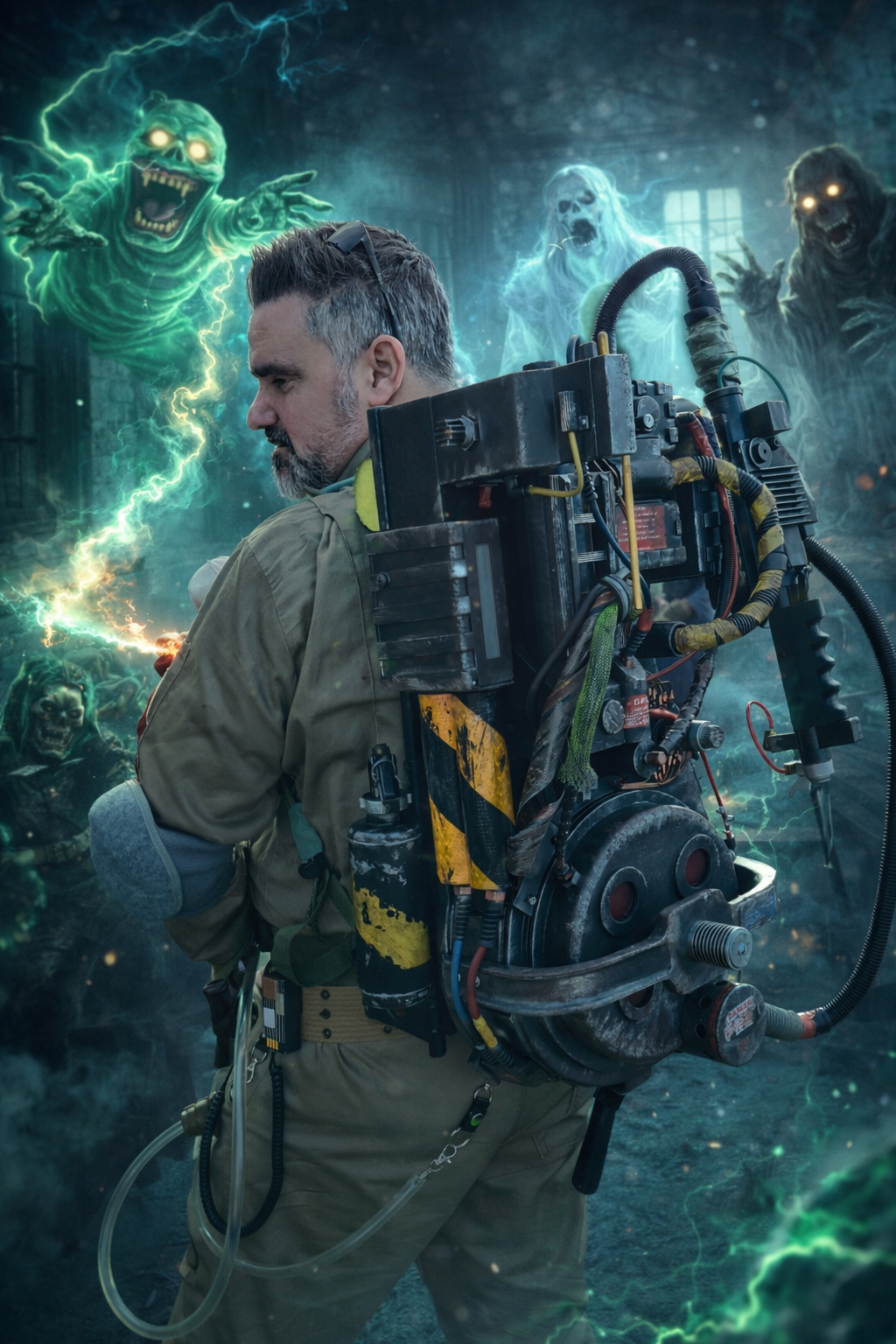
The Hornby Proton Pack
The Proton Pack is the primary handheld weapon system developed and used by the Ghostbusters to combat hostile paranormal entities. First deployed in 1984, it remains one of the most dangerous and effective pieces of non-military equipment ever created.
Origins of the Proton Pack
The Proton Pack was developed by Dr Egon Spengler as part of a radical experimental approach to applied parapsychology. Designed to generate a focused stream of charged particles, the pack allows the user to interact physically with otherwise intangible entities.
Early prototypes were built using a mixture of repurposed scientific equipment, improvised power regulation systems, and custom-designed components. The result was highly unstable but revolutionary technology.
Despite the risks, the Proton Pack proved capable of restraining, damaging, and manipulating ghosts long enough for containment to occur.
Design and Core Components
A standard Proton Pack consists of several critical systems:
- High-energy cyclotron housing the main power source
- Particle accelerator system for stream generation
- Power cell and regulation assemblies
- Neutrino wand for directional control
- Heat dissipation and venting arrays
The system is worn as a backpack unit, with the neutrino wand connected via a reinforced energy conduit. This design allows mobility while maintaining sufficient distance from the main power source.
Operational Dangers and Pitfalls
The Proton Pack is notoriously unsafe. Its power output is comparable to small-scale nuclear reactions, and improper handling can result in catastrophic consequences.
Documented risks include:
- Severe radiation exposure
- Thermal overload and venting failure
- Uncontrolled particle discharge
- Structural damage from crossed streams
One of the most infamous warnings associated with Proton Pack use is the prohibition against crossing streams. Doing so can cause unpredictable feedback, potentially resulting in total protonic reversal on a catastrophic scale.
Field Use and Evolution
Throughout the events of 1984 and subsequent major paranormal incidents, the Proton Pack underwent incremental refinements. Adjustments were made to improve stream control, durability, and field reliability.
Despite these improvements, the core design philosophy remained unchanged: maximum effectiveness at the cost of safety. The Ghostbusters accepted this risk as necessary given the scale of the threats they faced.
The Afterlife Rediscovery
Decades later, original Proton Pack units resurfaced during renewed paranormal activity. One such pack was discovered stored in a rural dirt barn, where it had been left unused and exposed to the elements for an extended period.
Environmental exposure, dust accumulation, and long-term neglect caused the pack’s exterior to degrade significantly. Dirt became embedded into seams, vents, and surface textures, bonding with residue from previous ectoplasmic encounters.
The Spengler / Afterlife Pack
This specific Proton Pack, based on the Spengler-era design, was recovered and reactivated during the events surrounding the resurgence of Gozer. It retained its original construction, bearing visible signs of age, use, and environmental damage.
Attempts to clean the unit proved largely ineffective. The grime and wear were not superficial; they had fused into the surface through years of heat cycling, residue exposure, and physical stress.
Transfer to Ghostbuster Hornby
Following its rediscovery, the pack was entrusted by Gary Grooberson to Ghostbuster Hornby for continued operational use. Rather than being restored cosmetically, the decision was made to preserve its condition as a working artefact.
The weathering tells the story of the pack’s survival. Each mark reflects time spent dormant, reactivated, and returned to service in the face of renewed threats.
Use Against Gozer and the Frozen Empire
The pack was subsequently deployed during the second known resurgence of Gozer and later during the New York events associated with the Frozen Empire incident.
Repeated exposure to extreme cold, paranormal energy surges, and prolonged operation further embedded the pack’s worn appearance. The dirt and grime became part of its identity, a record of continued resistance against forces that refuse to remain dormant.
Current Status
- Classification: Operational historical equipment
- Condition: Heavily weathered but functional
- Operational risk: High
- Assigned operator: Ghostbuster Hornby
This Proton Pack stands as a symbol of endurance rather than perfection. It was never meant to be clean, safe, or elegant. It exists to do one thing: stand between the living world and forces that would otherwise overwhelm it.